Physical Address
304 North Cardinal St.
Dorchester Center, MA 02124
Physical Address
304 North Cardinal St.
Dorchester Center, MA 02124

A moment of realisation: building a healthcare app is not the same as building a SaaS dashboard or an e-commerce storefront. The stakes are different. The rules are stricter. And the minute you start scaling: adding users, onboarding new clinics, expanding from the US to the UK, the compliance layer doesn’t just get “a little more complex.” It can completely break what you built if it wasn’t designed right from day one.
We’ve worked with healthcare startups, established medical providers, and everything in between. And the single most common mistake we see? Teams that treat compliance as a phase, something they’ll “add later”, instead of as foundational architecture. By the time they try to scale, they’re rebuilding half the product.
This blog is for founders, tech managers, CTOs, and healthcare management administrators who are either building from scratch or trying to scale an existing product without landing in a regulatory nightmare.
Before we get into the how, let’s zoom out a second.
The global digital health market is projected to grow from US$177.77bn in 2026 to US$219.60bn by 2030. A CAGR of 5.4% over just four years. That’s a structural shift in how healthcare is delivered. (Statista)
Meanwhile, as per Forbes, large healthcare breaches in the US alone exposed 276 million records in 2024, more than nine times the volume from five years ago, and the average cost of a healthcare data breach has now reached $7.42 million in 2025.
And here’s what makes this particularly sobering: in 2024, only 36% of available health apps complied with international data protection standards like HIPAA and GDPR, even as 42% of users said they actively worried about data security and third-party access.
So we have: explosive market growth + catastrophic breach costs + most apps still failing basic compliance. That’s the exact tension every healthcare app development company in the USA and UK is navigating right now.
Most people think of compliance as a binary; you either pass the audit, or you don’t. But when you’re scaling a healthcare product, it’s actually a dynamic system. New features, new user types, new geographies, new integrations, each one is a potential compliance event.
Here’s what scaling actually touches:
▶️The rule we follow at Tech Exactly: Compliance architecture should be designed for where the product will be in 3 years, not where it is today.
There’s no single silver bullet here; compliant architecture is a stack of deliberate decisions made at the right moments in your build. Get them right early, and they compound in your favour. Get them wrong, and every new feature, every new market, every new integration becomes a renegotiation with your own codebase.
The sections below break down where those decisions live and what they actually look like in practice.
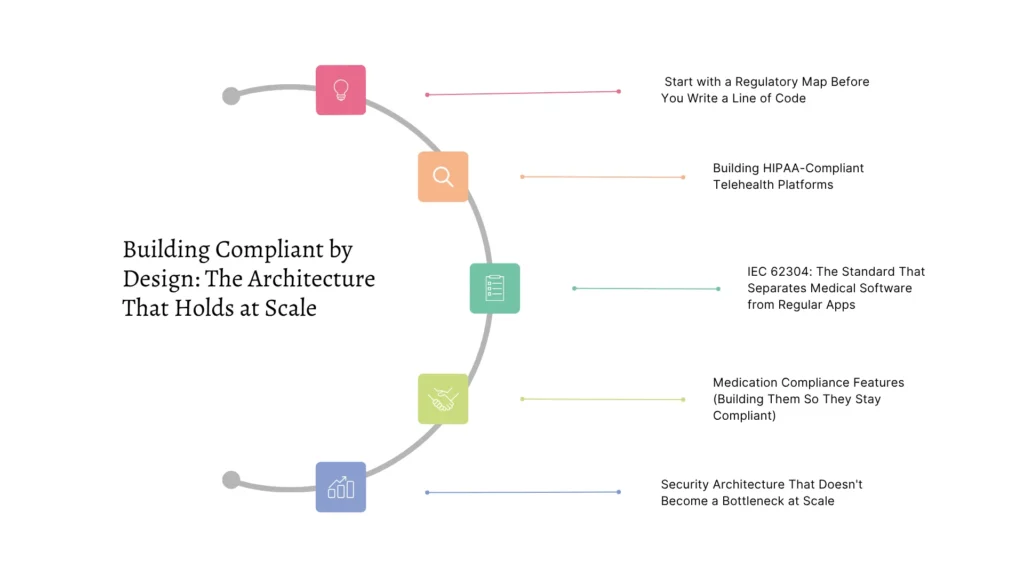
The biggest time sink in healthcare mobile app development services is retrofitting compliance after the architecture is set.
Before sprint one, you need clarity on:
We’ve written a deep-dive on this exact topic, covering how US and UK regulatory frameworks differ, and what to prioritize at each stage: Healthcare App Compliance in USA & UK: HIPAA, GDPR, FDA, UKCA
Telehealth platforms are one of the fastest-growing categories in digital health. The telemedicine market is projected to grow at a CAGR of 17.27% from 2025 to 2032, and with that growth comes serious regulatory scrutiny.
A telehealth platform that is HIPAA compliant isn’t just one that encrypts data in transit. It has:
For online telemedicine platforms specifically, the common failure points are video infrastructure (many teams use off-the-shelf video SDKs that haven’t signed a BAA) and session storage (recordings stored without proper PHI controls).
Among telemedicine software companies that have gotten this right, the common thread is architecture-level isolation of PHI. It’s not mixed with operational data, and a separate access policy governs it.
Want a practical checklist? We’ve covered the full technical implementation here: HIPAA Compliant Mobile App: What Developers Actually Need to Build
If your app qualifies as a medical device or the software component of one, you’re working under IEC 62304. This is the international standard for the lifecycle of medical device software, and it’s non-negotiable for regulated markets in both the US and UK.
Why is this important?
Because IEC 62304 mandates a software development lifecycle (SDLC) with explicit documentation, risk management, and traceability. Meaning every feature you build needs to be tied back to a documented requirement, tested under a defined protocol, and approved through a formal review process. That’s very different from a typical agile sprint cycle.
Here’s what building an IEC 62304 mobile app looks like:
Use Case: IEC 62304 Compliant App for Accurate Test Interpretation
A client came to us needing a mobile app to support accurate in-vitro diagnostic test interpretation: clinical-grade accuracy, used by lab technicians and physicians. The regulatory requirement was clear: IEC 62304 compliance throughout the entire development lifecycle.
We built the entire SDLC around the standard from day one: formal software requirements specification, hazard analysis, a documented architecture that isolated the critical interpretation logic, and a complete validation suite tied to a traceability matrix. The result was a fully auditable, Class B-compliant product that could stand up to regulatory review.
You can read the full case study here: IEC 62304 Compliant Mobile App for Accurate Test Interpretation
One of the most requested features in healthcare mobile app development is medication management: reminders, schedules, adherence tracking, and prescription history. It sounds straightforward. It isn’t.
An app that is truly compliant with medication management functionality needs to navigate:
The practical approach is to isolate medication data under a dedicated PHI data model with its own access policy, and to treat every medication-related user action as an auditable event. This also makes your product far easier to integrate with EHR platforms and pharmacy APIs at scale.
Compliance and security are related but not identical. A system can be technically compliant and still have critical security gaps or conversely, have an excellent security posture but poor documentation that fails an audit.
At scale, you need both. Here’s the architecture we recommend for medical mobile app development:
Data Layer
Application Layer
Infrastructure Layer
Operational
We’ve gone deep on the technical implementation of this stack here: How to Secure Healthcare Apps: Architecture, Encryption & Access Control
A lot of healthcare app development companies in the USA hit a wall when they try to enter the UK market (and vice versa). The frameworks look similar on the surface; both care about patient privacy, data security, and access controls. But the differences matter in production.
| What’s Different | USA (HIPAA/FDA) | UK (GDPR/UKCA/CQC) |
| Privacy basis | PHI-based consent model | Rights-based GDPR consent (more granular) |
| Data breach notification | 60-day window to notify HHS | 72-hour window to notify ICO |
| Medical device software | FDA SaMD guidance | UKCA/MDR (post-Brexit independent pathway) |
| Health data transfers | Within the US by default | UK-EU data transfer rules apply |
| Regulatory body | HHS Office for Civil Rights | ICO + MHRA |
For any healthcare app development company in the UK building products that also serve US patients or US companies expanding into the NHS ecosystem, this isn’t just a legal concern. It affects your data model, your consent UI, your breach workflows, and your infrastructure topology.
The full breakdown lives here: Healthcare App Compliance: USA & UK — HIPAA, GDPR, FDA, UKCA
Building a telemedicine product is its own category of complexity. It combines healthcare mobile app development with real-time communication, scheduling, EHR integration, prescription management, and, depending on your market, cross-state or cross-border clinical licensing requirements.
The non-negotiable foundation for any telemedicine app development:
Full telemedicine development framework here: Telemedicine App Development Guide: Architecture, Compliance & Stack
Compliance used to mean slower, more expensive development. That’s changed significantly because the tooling has matured.
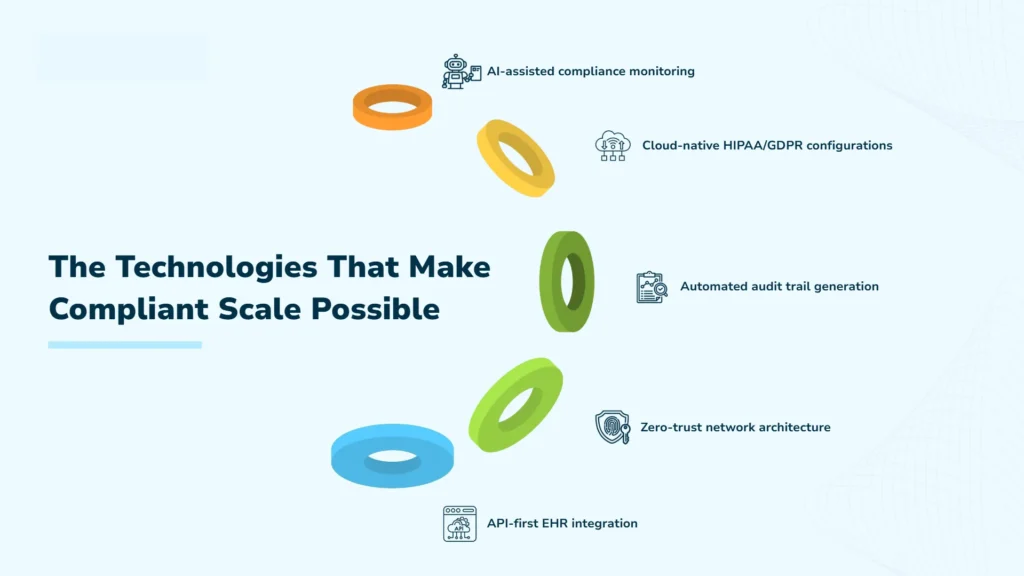
The technologies that are enabling healthcare mobile app development company to ship faster without cutting corners:
We’ve written a full technology stack breakdown here: Technologies in Healthcare App Development: What’s Actually Being Used in 2025
We’ll be honest, checklists in compliance content are everywhere, and most of them feel like they were written by someone who has never actually sat in a sprint review trying to explain to a developer why their logging setup is a HIPAA liability. This one comes from real project experience. We’ve seen each of these items be the exact thing that delayed a launch, failed an audit, or turned a minor incident into a reportable breach.
Run through it seriously, not as a box-ticking exercise.
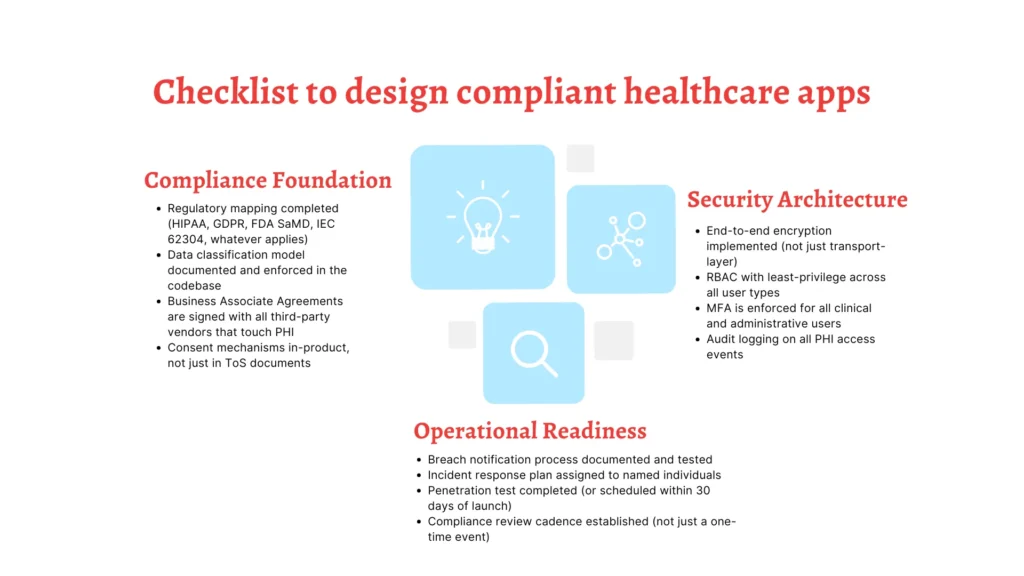
Compliance Foundation
Security Architecture
Operational Readiness
More detail on each of these: How to Build Regulatory Compliant Apps: A Practical Guide
The teams that ship the best healthcare products and scale them successfully are the ones that stopped treating compliance as a burden and started treating it as a product feature. Because to your users, whether they’re patients, clinicians, or healthcare management administrators, a system they can trust is more valuable than a merely functional system.
💡Expert Tip: The single fastest way to assess where your compliance gaps actually are? Map every place PHI touches a third-party service: analytics, notifications, video, error monitoring and check whether a BAA exists for each one. In our experience, that exercise alone surfaces 60–70% of the actionable risk in most early-stage healthcare products, and it takes an afternoon, not a full audit.
So, build for trust. Build for scale. Build for the regulatory environment you’ll be operating in three years from now, not just today.
If you’re building a healthcare mobile app, whether it’s a telemedicine platform, a medication management tool, or a clinical decision support system and you want to do it right the first time, Tech Exactly’s healthcare app development team has built compliant, scalable products across the US and UK markets.
Let’s build something that holds up.
Q1. What’s the difference between HIPAA compliance and being “secure”?
HIPAA is a legal framework; it tells you what to protect and how to document it. Security is the technical implementation. You can have strong encryption and still fail a HIPAA audit if your access logs, BAAs, or breach response process aren’t documented. You need both.
Q2. Does every healthcare app need to follow IEC 62304?
Only if your app qualifies as medical device software, meaning it’s used for diagnosis, treatment decisions, or clinical guidance. General wellness or appointment-booking apps typically don’t fall under IEC 62304. If you’re unsure, classify early; retrofitting the standard mid-development is expensive.
Q3. Can a US-built healthcare app operate in the UK without changes?
Rarely without modifications. HIPAA and UK GDPR differ on consent granularity, breach notification windows (60 days vs. 72 hours), and data transfer rules. If your app handles medical device functionality, you’ll also need UKCA compliance instead of FDA clearance.
Q4. What makes a telemedicine platform truly HIPAA compliant?
Three things most teams miss:
(1) a signed BAA with your video infrastructure provider,
(2) session metadata and recordings stored under PHI-level controls, and
(3) a documented, tested breach notification workflow, not just a policy in a Google Doc.
Q5. How early should compliance architecture be planned?
Before sprint one. The data classification model, regulatory mapping, and access control design should all be locked before UI or feature development begins. Every week you delay adds a compounding rework cost.Q6. What happens if we scale to new user types or geographies after launch?
Each expansion is a compliance event. New user roles (e.g., administrators, care coordinators) require RBAC updates. New geographies trigger new regulatory obligations. Build your architecture to accommodate this; don’t design it only for your current user profile.