Physical Address
304 North Cardinal St.
Dorchester Center, MA 02124
Physical Address
304 North Cardinal St.
Dorchester Center, MA 02124

With digital payments taking center stage in worldwide business operations, the burden on payment infrastructure has never been greater. Whether developing a financial technology service, an online marketplace, or a software-as-a-service offering, the capacity to design a payment system could make or break your venture.
Not only do payment errors cost organizations financially, but they can also affect their reputation and compliance requirements. With today’s consumers demanding quick and seamless transactions, any delays can result in lasting implications.
As per this study by McKinsey, shows that real-time payment failures directly impact trust and retention.
This is the reason why contemporary engineers are looking into how to redesign payment systems. Rather than sticking to monolithic and highly coupled systems, efforts have shifted towards designing scalable, robust, and fault-tolerant payment systems.
Building a payment infrastructure does not only involve executing payments but also making sure that the payments execute consistently. The bigger the company becomes, the more transactions happen, the more edge cases arise, and the higher the complexity of dependencies in the system.
Bad payment architecture may lead to:
This industry research portrays common payment system failures in distributed systems, which stem from poor architectural decisions.
Good payment architecture will ensure:
Even such an important yet small element like payment page design may become crucial in ensuring the success of the payment. The badly optimized interface can cause people to abandon their carts, while good optimization will provide better conversion.
This Baymard research shows the UX impacts conversion rates and reduces abandonment.
Together with good backend design and proper frontend execution using the most advanced technologies (such as mobile app development with React), payment systems can bring companies much more value than initially planned.
One of the key payment system principles is idempotency. It ensures that several repeated identical requests will produce the same effect.
Examples include:
Without idempotency, such situations would cause duplicated payments. To prevent it from happening, an idempotency key for each transaction request should be created. The principle is particularly essential in distributed environments, since failure is inevitable.
Operations should not be performed synchronously in payment systems, but in an asynchronous manner.
For example:
The usage of asynchronous communication patterns via messages between systems makes it possible to decouple the system’s components, increasing its scalability and responsiveness in cases of heavy traffic.
All of this aligns with the best practices followed around event-driven architecture for scalable systems used in modern distributed applications.
All information regarding transactions must be accurate at all times when implementing a reliable payment system. The use of a double-entry ledger is crucial in that case.
Every operation is registered as:
It provides:
Properly set up, your double-entry ledger will become a single source of truth for all your accounting operations.
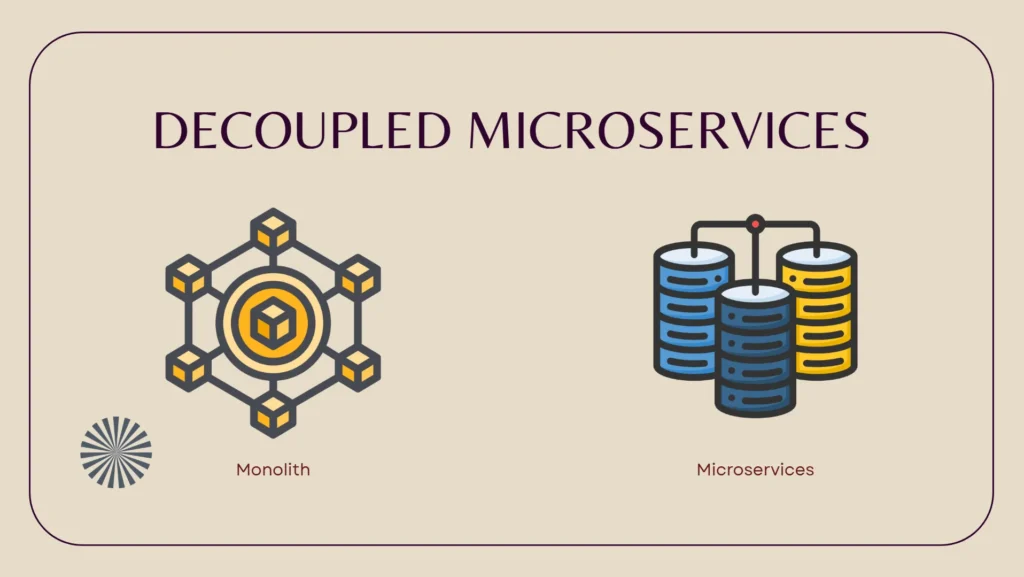
Scaling in monolithic architecture is challenging. It works well when dealing with the application itself, but does not allow scaling different system components separately.
In a microservice environment, we can scale:
The implementation of this pattern is quite often combined with cross-platform mobile app development services to maintain high responsiveness regardless of device. The martinfowler approach reflects the growing adoption of microservices architecture for building scalable applications in high-growth systems.
More on Microservices architecture, you would like to read: Microservices vs Monolithic Architecture: Best choice for SaaS.
The performance of payment systems’ databases depends greatly on transaction load.
To scale properly:
Some examples of the criteria that can be used to shard transactions are:
Teams often implement database sharding strategies for high-scale systems to handle increasing transaction volumes efficiently.
Payment systems often depend on external providers such as payment gateways and banks. If one provider fails, your system must seamlessly switch to another.
Intelligent routing helps:
Failover mechanisms ensure that transactions are not disrupted during outages.
A circuit breaker pattern prevents cascading failures in distributed systems.
If a service starts failing:
This protects the system from overload and ensures stability during partial failures.
Payments are not a single event; they are a sequence of states.
For example:
Using a state machine model ensures:
It also makes it easier to handle retries and edge cases systematically.
To ensure high availability, payment systems must operate across multiple regions.
This includes:
Geographic redundancy ensures that even if one region goes down, the system continues to function without disruption.
The orchestrator acts as the central coordinator for payment workflows.
It:
A well-designed orchestrator ensures that complex workflows remain manageable and consistent.
This is the financial core of your system.
It:
Any inconsistency here can lead to serious financial and compliance issues, so this component must be designed with extreme care.
Reconciliation ensures that your internal records match external payment providers.
This involves:
Automated reconciliation systems are essential for scaling operations without manual intervention.
Security is non-negotiable in payment systems.
Key considerations include:
Adhering to PCI DSS compliance requirements for payment systems is critical for protecting sensitive financial data. Security must be embedded into the system from the ground up, not added as an afterthought.
To maintain system health, continuous monitoring is essential.
Track metrics such as:
Observability tools help teams detect issues early and respond proactively.
Payment systems must handle unpredictable spikes in traffic.
This includes:
Using auto-scaling infrastructure and load testing strategies ensures that your system can handle sudden surges without failure.
These are not just advanced strategies; they are fundamental mobile app development tips for any team building scalable financial systems.
Creating payment systems that scale without any failures is challenging yet necessary. Such systems need to be developed with solid architectural guidelines and resilient infrastructure.
From applying the use of idempotency and asynchronous operations to taking advantage of microservices architecture and geographic redundancy, every choice contributes to building a reliable system.
The primary lesson here is clear: design for failure. Those systems that rely on everything going right are the first to fail.
For companies looking to expand worldwide, focusing on creating an efficient payment system architecture that is often aided by professional teams providing Custom Mobile App Development Services in the USA and Custom Mobile App Development Services in the UK is crucial.
In summary, a well-thought-out payment system architecture is much more than just a technological solution; it is a strategic advantage.
Among all this, correctness and reliability are important. Transaction speeds should be atomic, further reducing the risk of application failures and fund loss.
PostgreSQL, a relational database, is seen as developers’ favourite for its ACID compliance and its strong consistency.
First, don’t store your credit card details in the app database. However, you can use tokenization for sensitive card information that is exchanged by the payment gateway.
For seamless consistency, designing is important, as I have discussed. To begin with, store the webhook event, acknowledge receipt, and allow background processing for status update.