Physical Address
304 North Cardinal St.
Dorchester Center, MA 02124
Physical Address
304 North Cardinal St.
Dorchester Center, MA 02124

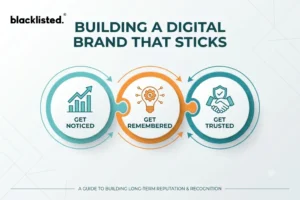
Most brands don’t fail because the product is bad. They fail because nobody remembers they exist.
You can have the best pricing, the best team, even the best idea in your category. Doesn’t matter. If people forget you the second they close the tab, you’re invisible. And invisible companies don’t grow.
So let’s talk about how to build a digital brand that actually sticks. Not a logo refresh. Not a “brand strategy” deck that sits in Google Drive forever. A real one.
Here’s the shift that matters. A brand used to mean a logo, a tagline, maybe a jingle. Now it’s every screenshot someone takes of your product, every reply your support team sends, every review that shows up when someone Googles your name at 11pm before deciding whether to buy. Digital brand building isn’t one project anymore. It’s dozens of small moments, all pulling in the same direction, or not.
Every founder wants their brand to feel “premium” or “authentic” or “bold.” Fine words. Useless without a position.
A position answers one question: who is this for, and who is it explicitly not for?
Liquid Death isn’t for people who want quiet, elegant water branding. It’s for people who think water marketing is boring and want to laugh at a skull on a can. That’s a position. It excludes people on purpose.
If your brand tries to please everyone, it lands with no one. Pick a lane. Own it loudly.
Try this. Write down three competitors. Now write down one sentence for each explaining what they stand for, in the customer’s words, not their marketing copy. If you can’t do it, they don’t have a position either. That’s your opening.
Getting that position out of your head and onto a screen is where most founders stall. This is exactly the gap a good creative agency fills: turning a rough sense of “who we are” into a visual language customers instantly recognize.
Here’s an uncomfortable truth. A mediocre brand shown 500 times beats a brilliant brand shown 5 times.
Coca-Cola’s logo hasn’t meaningfully changed since 1941. Same red. Same script. That’s not a lack of imagination. That’s discipline.
Pick your colors, your tone, your fonts, your way of talking to customers. Then repeat it everywhere: your website, your Instagram captions, your email footer, your invoices. People trust what they recognize. Recognition takes reps.
Most teams get bored of their own brand long before customers even notice it. That’s normal. You see your logo 500 times a week. Your customer sees it twice a month, if you’re lucky. Don’t change it just because you’re tired of looking at it.
I’ve read hundreds of “brand voice guidelines” documents. Most of them describe a robot pretending to be friendly.
Write the way you’d talk to a smart friend over coffee. Use “I.” Use “you.” Say what you actually think instead of hedging behind “it could be argued that.”
If your About page reads like a press release, rewrite it. Nobody bonds with a press release.
The same goes for social replies. When a customer complains publicly and your team responds with “We appreciate your feedback and are looking into this,” that’s not a voice. That’s a legal disclaimer wearing a smiley face. Say what actually happened. Say what you’re doing about it. People forgive mistakes. They don’t forgive being talked to.
A lot of founders still treat SEO like plumbing. Something you fix once and forget.
Wrong. Every time someone searches your category and finds you on page one, that’s a brand impression. Every time they find a competitor instead, that’s a brand impression too, just not yours.
This is why working with a genuine search partner can shift more than your traffic numbers. It shifts who shows up first in your customer’s mind at the exact moment they’re deciding who to trust. Rankings and reputation aren’t separate games anymore. They’re the same game.
People judge credibility in about 50 milliseconds, based almost entirely on visual design. That’s before they’ve read a single word of your copy.
A clunky website with mismatched fonts and stock photos of people laughing at salads tells visitors, subconsciously, that you’re not serious. It doesn’t matter how good your product is behind that homepage.
This is where a sharp design partner earns its fee. Not by making things “pretty.” By making every visual choice reinforce the same message: this company knows what it’s doing.
Blogs help. Ads help. But nothing builds trust faster than third parties vouching for you: reviews, case studies, press mentions, founder interviews on podcasts nobody outside your industry has heard of.
One case study with real numbers (“we cut support tickets by 34% in 90 days”) does more work than ten generic testimonials that say “great team, highly recommend.”
Specificity is what separates marketing from proof.
The fastest way to get remembered is to stop being the only voice in the room.
Build something people want to screenshot. A witty error message. An unboxing that feels considered. A founder who answers DMs personally instead of routing everything through a bot. Small, human touches get shared precisely because they feel unscaled.
I’ve seen a single well-timed reply on Twitter do more for brand recall than a $10,000 ad campaign. Not because the reply was clever marketing. Because it wasn’t marketing. It was just someone being genuinely helpful, in public, where others could see it.
Here’s the part most brand guides skip entirely. Getting noticed also means you can get noticed for the wrong reasons.
One bad partnership, one shady backlink scheme, one lawsuit, and your brand can end up Blacklisted from platforms, ad networks, or search engines before you even realize it’s happening. Recovery from that takes months, sometimes years, and plenty of the trust you built never fully comes back.
Audit your partnerships. Check who links to you. Know what your name is attached to. Reputation is an asset. Protect it like one.
This is doubly true if you’re paying anyone for growth shortcuts. Cheap backlinks, bought reviews, engagement pods. They might bump up a metric this month. They can also get your domain flagged, your ads account suspended, or your brand quietly buried in search results for reasons nobody bothers to explain to you. Slow and clean beats fast and risky, every time.
Nobody builds a memorable brand in a quarter. I wish I could tell you otherwise.
Six months in, you’ll feel like nothing’s working. Twelve months in, people will start recognizing your name unprompted. Eighteen months in, if you stayed consistent, customers will start recommending you without being asked.
That’s the actual finish line. Not a viral post. Not a rebrand. Someone mentioning your name to a friend without you paying for the privilege.
If you want a head start, teaming up with an experienced seo agency in india can compress that 18-month timeline considerably, since a chunk of “getting noticed” is just showing up correctly in search while everything else compounds.
Build for that. Everything else is noise. Start small, stay consistent, and let the compounding do what it always does.